
These days, hardly a week goes by without another headline announcing workforce reductions. Whether driven by restructuring, acquisitions, shifting business priorities, economic uncertainty, or advances in technology, workforce change has become a standard part of doing business. While announced job cuts have moderated compared to last year, U.S. employers still announced more than 443,000 planned job cuts during the first half of 2026—the second-highest January-to-June total since 2020.
For HR leaders, these announcements reinforce an important reality: organizational change isn’t an exception anymore. It’s an expected part of business strategy. The question isn’t whether your organization will experience change; it’s whether you’re prepared to lead people through it in a way that protects your culture, strengthens your employer brand, and reinforces trust.
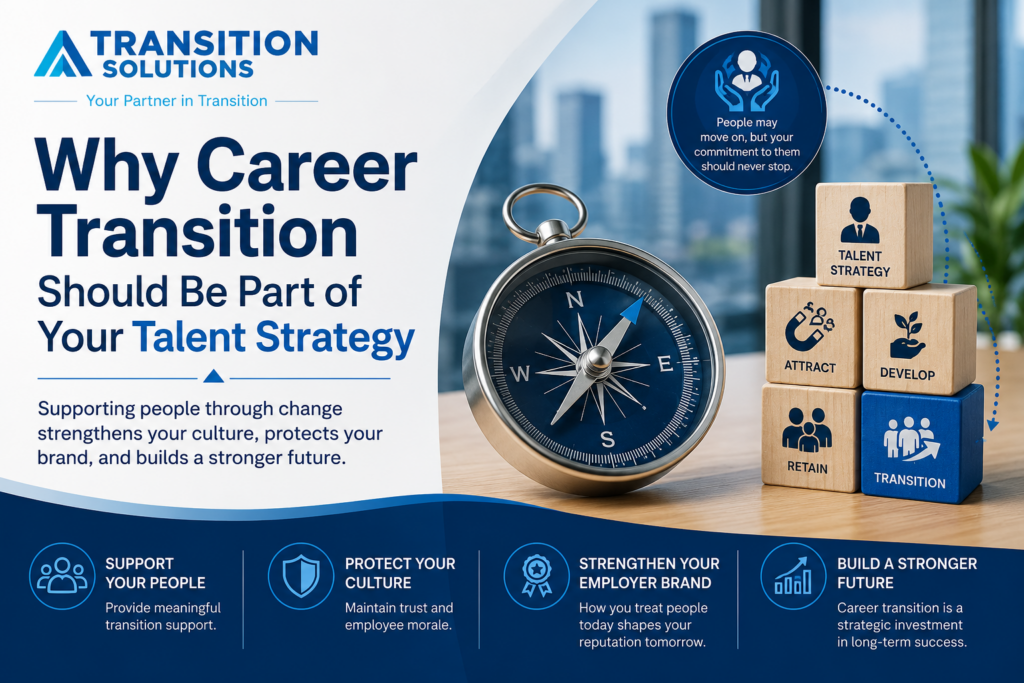
Too often, career transition is viewed as something that begins after a layoff has been announced. In reality, it should be part of your broader career-transition strategy and talent philosophy long before workforce changes become necessary. Organizations invest significant time and resources attracting, developing, and retaining employees. The best organizations also think carefully about how they support people when business needs require them to move on.
Career Transition Is Part of Talent Strategy
When people hear the term career transition, they often think only of outplacement following a reduction in force. While that’s certainly one application, career transition truly encompasses something much broader. It reflects an organization’s commitment to helping employees navigate change with dignity, respect, and meaningful support.
Whether an organization is restructuring departments, integrating teams after an acquisition, responding to changing market conditions, or adapting to new technologies, workforce transitions have become a regular part of business. How an employer manages those moments says as much about its culture as do its recruiting efforts or employee-development programs.
The organizations that consistently attract and retain top talent understand that every stage of the employee experience contributes to their reputation. Career transition isn’t separate from talent strategy; it’s an extension of it.
The Employees Who Stay Are Watching
One of the biggest misconceptions about workforce reductions is that only departing employees are affected. In reality, every workforce transition creates two audiences: the employees leaving and the employees staying.
Remaining employees naturally have questions. These may include:
- How were their colleagues treated?
- Did leadership communicate openly?
- Did the organization provide meaningful support?
- Did people feel abandoned once their positions were eliminated?
The answers to those questions influence morale, engagement, trust in leadership, and even future retention.
We’ve seen organizations invest heavily in recruiting and employee engagement only to undermine those efforts by handling workforce reductions poorly. Conversely, we’ve also seen organizations preserve trust during difficult transitions because employees recognized that leadership treated departing colleagues with empathy, professionalism, and genuine support.
Career transition isn’t simply about helping people leave well. It’s also about reinforcing confidence among the people who remain.
Career Transition Is About People, Not Programs
One of the biggest opportunities we see in an age of ongoing layoffs is helping organizations rethink what career transition actually means. Too often, it’s viewed as a checklist that includes top-level components such as:
- Resume writing
- LinkedIn profile updates
- Interview preparation
- Job board access
Those resources are certainly important, but they don’t represent the full experience of career transition. People don’t view career transitions as a checklist. They may see uncertainty or opportunity, and a lot of their viewpoint depends on the support they receive.
Many professionals who are suddenly thrust into a job search need to ask themselves questions they’ve never had to answer before, such as:
- How do I explain this layoff in interviews?
- Has my industry changed?
- Should I pivot into a different role?
- How do I use AI responsibly in my job search?
- Where do I even begin?
Effective career-transition support helps people answer those questions. It builds confidence, provides accountability, develops networking strategies, prepares candidates for today’s hiring process, and helps individuals regain momentum after an unexpected career disruption. A resume may open a door, but confidence, preparation, and strategy help people walk through it.
That’s why personalized coaching remains such an important part of successful career-transition programs.
Technology Should Enhance the Experience, Not Replace It
Technology has transformed career transition in meaningful ways. AI-powered tools, learning libraries, assessments, career dashboards, and virtual resources provide participants with immediate access to information and help them work more efficiently throughout their job search.
At Transition Solutions, we’ve embraced technology because it creates a better experience for both clients and participants. Our CareerDashboard™ gives individuals access to resources, learning opportunities, and tools that help them stay organized and informed throughout their search. But technology alone isn’t enough.
Career transitions are deeply personal. A dashboard can’t coach someone through a difficult interview, help them evaluate multiple job offers, encourage them after weeks of searching, or provide reassurance when confidence begins to fade. Those conversations require experienced career consultants who understand today’s hiring market and the emotional realities of career change.
The most effective career-transition programs don’t ask organizations to choose between technology and people. They combine both to create a more personalized approach that better supports the entire process.
Choosing the Right Career-Transition Partner
Not all outplacement providers take the same approach. As HR leaders evaluate career-transition partners, it’s worth looking beyond the list of services and considering the overall experience participants will receive. Ask questions such as:
- Is the program personalized, or does every participant receive the same experience?
- Will employees work directly with experienced career consultants?
- Does the provider support employees at every career level, from individual contributors to executives?
- Does technology enhance the coaching experience rather than replace it?
- Will this partner represent our organization in a way that reflects our values and employer brand?
The answers to those questions often reveal far more than a comparison of features or pricing. They help determine whether a provider will simply deliver services or become a trusted extension of your organization during one of its most challenging moments.
Career Transition Reflects Your Employer Promise
Every organization makes promises to its employees:
- We invest in your growth.
- We value your contributions.
- We want you to succeed.
Career transition is the opportunity to demonstrate that those promises still matter—even when business circumstances change.
Employees may not remember every meeting, project, or performance review, but they will remember how they and their colleagues were treated during periods of uncertainty. Those experiences shape employer brand, influence future recruiting efforts, and often become part of an organization’s reputation in the marketplace.
Organizations that recognize career transition as part of their talent strategy aren’t simply helping departing employees find new opportunities. They’re demonstrating leadership, reinforcing trust, protecting their employer brand, and showing that people remain at the center of their decisions.
That’s why career transition—and outplacement services—deserve to be viewed as more than a post-layoff benefit. They’re an essential component of a comprehensive talent strategy and a reflection of the values an organization chooses to uphold, even during its most difficult moments.
About Transition Solutions
For more than 35 years, Transition Solutions has partnered with organizations to deliver personalized career transition and outplacement services that support both employees and employers through workforce change. By combining experienced career consultants with innovative technology, we help organizations navigate transitions with confidence while empowering individuals to move forward successfully.
To learn more about our services, visit Transition Solutions, call 888-424-0003, or email info@transitionsolutions.com.
Follow our LinkedIn company page for additional insights on career transition, leadership, and workforce strategy.