
You know how the process goes. First, you find a job that is perfectly aligned with your experience and career goal. Next, you tailor your resume, perhaps craft a cover letter, upload the resume to the applicant tracking system, and wait to hear a response. Then days or weeks pass, and you think—as so many other applicants have: “The ATS must have rejected my resume.”
It’s a common story that our career consultants often hear from job seekers. Although ATSs have been part of the application process since the mid-1990s, there’s still a significant amount of disinformation and misunderstanding about how they actually work. The short story is that most of what you’ve heard about how applicant tracking systems are “out to get” job seekers simply isn’t true.
A recent report published by Huntr analyzed 1.7 million job applications, reviewed more than 225,000 resumes, and interviewed recruiters from organizations including Amazon, Microsoft, and Fortune 500 companies, and confirms what our consultants have seen firsthand for decades: Applicant tracking systems are tools that support the hiring process; they are not making hiring decisions.
Understanding how ATSs really work can help you spend less time worrying about myths and more time focusing on the strategies that actually lead to interviews.
What Is an Applicant Tracking System?
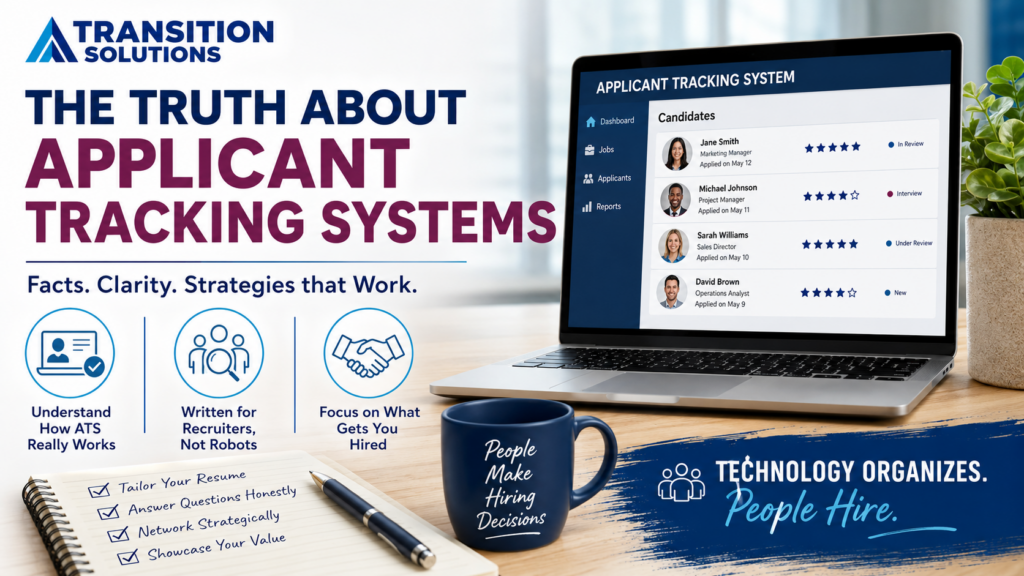
At its core, an applicant tracking system is a database. It stores applications, tracks candidates through the hiring process, organizes recruiter workflows, and keeps hiring information in one central location. Think of it as a digital filing cabinet rather than a decision-maker. Recruiters interviewed for the Huntr research repeatedly described ATS platforms this way, emphasizing that the systems organize information while people make hiring decisions.
When you apply online, the ATS typically:
- Stores your resume and application.
- Records your responses to application questions.
- Organizes your information for recruiter review.
- Tracks your progress throughout the hiring process.
That’s very different from the picture many job seekers have in mind.
What Really Happens After You Click “Apply”
Let’s pull back the curtain to walk you through the online hiring process. This is usually how it looks:
- You submit your application.
- The ATS records your information.
- Knockout questions, if the employer uses them, verify that you meet basic requirements such as work authorization, required certifications, or willingness to travel.
- A recruiter reviews qualified applications.
- Selected candidates move forward to the hiring manager.
- Interviews are conducted.
- The employer extends an offer.
Notice something important? The ATS doesn’t decide who gets hired; people do.
The only common automated disqualification comes from objective knockout questions that employers intentionally build into their applications. Beyond that, recruiters and hiring managers evaluate candidates and make decisions.
The Myths That Won’t Go Away
Unfortunately, outdated advice continues to circulate online. Let’s clear up a few of the biggest misconceptions when it comes to applicant tracking systems.
Myth: The ATS Automatically Rejects My Resume
This is probably the biggest point of contention for today’s job seekers, and the myth proliferates.
While some employers use knockout questions to automatically identify applicants who don’t meet basic requirements, major applicant tracking systems are not automatically rejecting resumes because of formatting or missing keywords. Recruiters interviewed in the Huntr study consistently reported that qualified applications are reviewed by humans.
If you aren’t moving forward in the application process, it’s much more likely that another applicant was a stronger match for the position, the role was filled quickly, or your qualifications didn’t align closely enough with what the employer needed.
Myth: There’s an “ATS Score”
Many websites promise to calculate an ATS score and suggest that recruiters will see a number attached to your resume. They don’t. There is no universal ATS score.
Resume-scoring tools can be useful for comparing your resume against a job description, but they are measuring their own criteria, not what an employer’s applicant tracking system actually displays.
Don’t fall into the trap of optimizing for a score that a recruiter will never see.
Myth: You Need to “Beat” the ATS
This is where many job seekers spend too much time and energy. Your goal isn’t to outsmart the applicant tracking system. Instead, it’s to clearly demonstrate why you’re qualified when a recruiter opens your resume.
A clean layout, relevant experience, measurable accomplishments, and language that naturally reflects the job description will always outperform gimmicks designed to “beat the system.” Write for the recruiter, not the software.
Myth: Every Resume Must Be One Page
This advice has been repeated for decades, but today’s research paints a different picture. Huntr’s analysis found that two-page resumes performed as well as—or better than—one-page resumes across every experience level.
Perhaps the better question isn’t, “How long should my resume be?” Instead, it’s, “Have I clearly demonstrated that I’m qualified for this position?”
If it takes two well-organized pages to tell that story, that’s perfectly acceptable. Don’t get stuck on length.
What Recruiters Actually Look For
One of the most fascinating findings from this recent research is how quickly recruiters perform an initial review. Most spend just 6–10 seconds determining whether a resume deserves a closer look. During that first scan, they’re asking practical questions:
- Does this person meet the qualifications?
- Is their experience relevant?
- Have they solved similar problems?
- Can I quickly understand the value they bring?
If the answers are yes, they’ll continue reading. If not, they’ll move to the next application. That’s why clarity matters so much. A resume doesn’t need to impress software. It needs to help a busy recruiter quickly recognize that you’re a strong fit for the role.
What Job Seekers Should Focus on Instead
Rather than worrying about ATS myths, invest your energy in the things that actually improve your chances of getting an interview:
- Tailor your resume to each position. Incorporate relevant language from the job description naturally—not by stuffing keywords, but by accurately reflecting your experience.
- Answer knockout questions honestly.
- Keep your formatting clean, professional, and easy to read.
- Apply as early as practical, since recruiters often begin reviewing candidates immediately after a position is posted.
Even with all that preparation, one of the aspects too many job seekers overlook is relationships. Networking, referrals, and meaningful professional connections remain some of the most effective ways to stand out in today’s job market. A strong online application is a start, but you’ll seal the deal with your connections.
Technology Supports Hiring. People Make Hiring Decisions.
At Transition Solutions, our consultants work with job seekers every day. We understand the technology that supports today’s hiring process, and we also understand the people behind it. That’s why we coach our clients to stop worrying about “beating the ATS” and start focusing on presenting their qualifications clearly, strategically, and authentically.
Technology will continue to evolve. Applicant tracking systems will continue to improve. Artificial intelligence will become more integrated into recruiting workflows. But one thing remains unchanged: People hire people.
The applicant tracking system isn’t your competition. It’s simply one tool employers use to organize applications and manage the hiring process. Your time is far better spent creating a compelling resume, building meaningful professional relationships, preparing for interviews, and demonstrating the value you bring to an organization.
When you understand how applicant tracking systems really work, you stop chasing myths—and start focusing on the strategies that truly move your job search forward.
At Transition Solutions, we have been helping companies and individuals navigate workforce changes for more than 35 years. Our experienced career consultants provide personalized guidance that helps job seekers confidently manage every stage of the career transition process—from application through offer.
To learn more about our services, visit Transition Solutions at www.transitionsolutions.com, call 888-424-0003, or email info@transitionsolutions.com.
And be sure to follow our LinkedIn company page for career advice, job-search strategies, and workforce transition insights.