
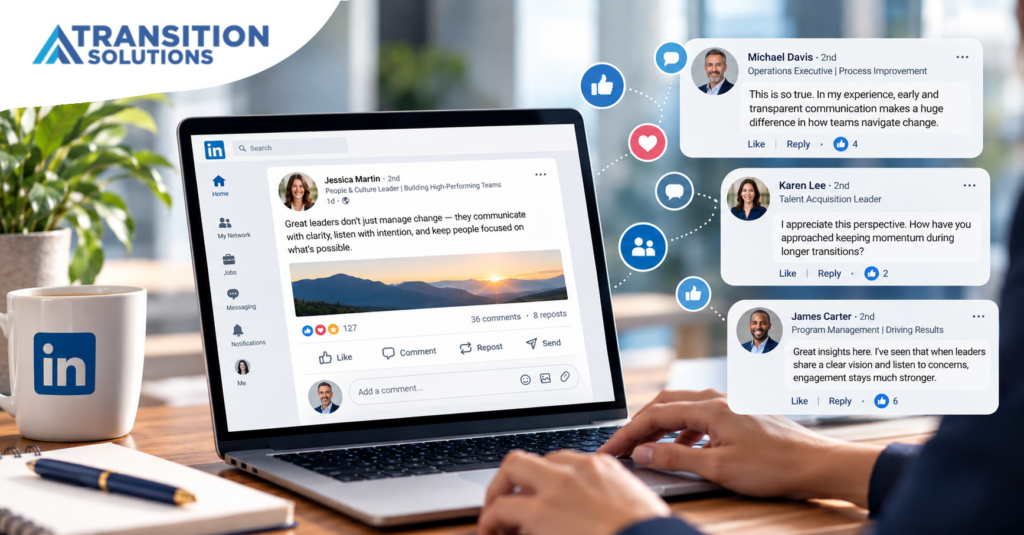
When you’re looking for a new role, much of your time naturally goes toward activities with an obvious connection to your goal: identifying opportunities, tailoring your resume, contacting people in your network, and preparing for interviews. Those activities matter. But there’s another part of the job search that is easy to overlook: demonstrating your professional value before you ever enter an interview. When you build credibility on LinkedIn, you go a long way toward achieving this goal.
A well-developed profile communicates your experience, accomplishments, and qualifications. That’s just the start. Thoughtful comments and relevant posts add another dimension. They give people a chance to see your perspective, recognize your expertise, and understand how you engage with others in your field.
Why is this important for job seekers? Because professional credibility is built through more than a list of credentials. People also pay attention to how you communicate, the questions you ask, the ideas you contribute, and the way you respond to different perspectives. Your activity on LinkedIn can help make those qualities visible.
The objective isn’t necessarily to become a content creator. It’s to participate in your professional community in a way that supports your career goals.
Why Visibility and Credibility Work Together
Visibility and credibility are related, but they aren’t the same thing.
Visibility means people have opportunities to notice you. They recognize your name, see your contributions, and become familiar with your professional interests. This is achieved by showing up—consistently—in conversations.
Credibility develops as your network gains a better understanding of your judgment, knowledge, experience, and approach. That leads to trust and a deeper knowledge of who you are and why they should share referrals with you.
Creating visibility doesn’t automatically mean that you gain credibility. Posting frequently may make your name familiar, but frequency alone won’t establish your expertise. A thoughtful contribution to a relevant conversation, on the other hand, can demonstrate more about your professional perspective than several generic updates.
Consider the difference between saying, “Great post!” and adding a comment that explains which idea resonated with you, why it matters in your industry, or how you’ve seen it play out in practice. Both are positive responses, but the second gives readers something more substantial to consider.
Over time, meaningful interactions can help you develop professional relationships and make your strengths easier for others to recognize. They may also create openings for conversations, introductions, and referrals. None of these outcomes is guaranteed, but each becomes more possible when people have a clearer sense of who you are and what you contribute.
This is especially relevant during a career transition. When you’re no longer in a position where colleagues and leaders regularly see your work, you may need to be more intentional about communicating your value to the professional community you want to reach.
Start with Comments: Join the Conversation
If posting on LinkedIn feels uncomfortable, begin by commenting on other people’s content. You don’t have to publish an original post to participate meaningfully, and commenting can be a practical way to build confidence before sharing more of your own ideas.
Start with your existing network. Review posts from former colleagues, industry peers, professional associations, and people working in organizations or roles that interest you. Look for subjects you genuinely care about or know something about. When you have a useful thought to contribute, add it to the conversation.
A good comment doesn’t have to be long. It should, however, offer something beyond a generic reaction when you have more to say. For example, suppose a former colleague posts about the challenges of leading a team through organizational change. You might simply write, “Great insights!” That is supportive, but it doesn’t reveal much about your own perspective.
A more substantive response could acknowledge a specific point and explain why it matters: “Your point about communicating early is particularly important. In my experience, employees are often better able to navigate change when leaders explain what is known, what remains uncertain, and when they can expect another update.”
The second comment demonstrates professional judgment while keeping the conversation focused on the original post. It also gives other readers a glimpse of your experience without turning the discussion into a sales pitch. A few principles can help guide your approach:
- Be relevant. Engage with subjects connected to your professional interests, experience, or target roles.
- Add value. Share a perspective, ask a thoughtful question, or build on an idea that someone else introduced.
- Be professional. Disagreement is sometimes appropriate, but a public comment is not the place to score points at someone else’s expense.
- Be genuine. Comment because you have something meaningful to contribute, not simply because you want your name to appear in more places.
LinkedIn has publicly stated that it is working to reduce inauthentic engagement, including automated comments and coordinated engagement tactics. That reinforces a sensible principle for job seekers: prioritize real participation over manufactured activity. LinkedIn’s guidance on authentic content and conversations makes clear that meaningful engagement is central to the professional experience the platform aims to support.
Use Your Own Posts to Demonstrate Expertise
Comments help you participate in conversations that are already happening. Original posts give you space to introduce ideas, explain your perspective, and share what you know.
You don’t need to invent a groundbreaking insight every time you publish something. Start with the questions you answer at work, the challenges you’ve helped solve, the lessons you’ve learned, or the developments in your industry that deserve attention.
For a job seeker, three broad content areas can provide a useful starting point: your career direction, your professional expertise, and the interests that help people get to know you.
1. Share Your Career Direction
If you’re looking for a new position, make it easier for your network to understand what you’re seeking and how people might help. Note that you’ll want to skip this option if you’re gainfully employed; you wouldn’t want to do anything that could jeopardize your current role.
A vague announcement that you’re “open to opportunities” doesn’t give readers much to work with. A more specific post can identify the types of roles you’re targeting, the problems you solve, the industries that interest you, or the experience you would bring to an organization.
For example, a project management professional might explain that they are interested in opportunities involving cross-functional initiatives, process improvements, and complex implementations. They could describe a relevant accomplishment and invite connections to introduce them to people working in those areas. The goal is not to publish your entire job-search strategy. It’s to provide enough context for people to recognize a potential connection or opportunity.
You can also share relevant progress, such as completing a professional certification, attending an industry event, or learning something useful during your search. Keep the emphasis on what you’ve learned and where you’re headed rather than turning every update into an announcement that you’re unemployed.
2. Demonstrate Your Professional Expertise
Your experience is one of your most valuable assets in a job search, but people can’t always infer your capabilities from your title or resume alone. Sharing your perspective gives you another way to demonstrate them.
Think about the problems you’ve solved, the decisions you’ve helped make, and the lessons you’ve learned throughout your career. What do colleagues regularly ask you about? What mistakes have you learned to avoid? What changes are affecting your industry? Which practices have helped you improve a process or achieve a better result? Those questions can generate useful post ideas.
A finance professional might explain a common budgeting misconception. An HR leader might discuss an approach to improving employee retention. A marketing professional might share a lesson from a campaign that didn’t produce the expected results and explain what changed as a result.
You can also share an article or industry report—but be sure to add your own perspective. Explain what caught your attention, why the subject matters, or how it connects to your experience. Simply reposting a headline provides less insight into your expertise than explaining what you think about it.
This is where specificity matters. You don’t need to teach an entire course in one post. A clear observation, a practical example, or a well-reasoned question can be enough to start a meaningful discussion.
3. Let People Get to Know You
Professional credibility doesn’t require you to present yourself as a collection of skills and accomplishments. Your interests, values, and personality can also help people connect with you.
Sharing an appropriate personal interest, a professional milestone, a volunteer activity, or a lesson learned outside work can give your network a fuller picture of who you are. These details may become natural conversation starters when you reconnect with former colleagues or meet new contacts.
Use your judgment about what to share. LinkedIn is a professional platform, so consider whether a post supports the impression you want to make with colleagues, recruiters, hiring managers, and potential employers. Remember that you’re networking, and whatever you share on LinkedIn should be something that would be equally appropriate in the office break room or at a networking event.
You don’t need to disclose private details to appear personable, and you don’t have to share personal content at all if it doesn’t feel natural to you. The objective is to communicate authentically, not to manufacture a personal brand that doesn’t reflect who you are.
Be Consistent without Turning LinkedIn into Another Full-Time Job
One of the biggest barriers to participating on LinkedIn is the assumption that doing it well requires constant activity. It doesn’t.
You don’t need to publish every day, comment on dozens of posts, or maintain a complicated content calendar to build credibility on LinkedIn. A sustainable approach is more useful than an ambitious schedule that quickly becomes another source of stress during an already demanding job search.
Choose a level of participation you can maintain. You might begin by leaving two thoughtful comments each week. Once that feels comfortable, add an original post when you have a relevant idea to share. Or you might prefer to publish occasionally while participating regularly in discussions related to your field. The right cadence depends on your goals, schedule, and comfort level. What matters is that you engage intentionally rather than treating LinkedIn as a task to complete as quickly as possible.
It also helps to pay attention to the quality of your interactions. Are you reconnecting with relevant people? Having useful conversations? Learning about developments in your industry? Helping others understand your experience and interests? Those are more meaningful questions than whether a particular post received a certain number of likes. They’ll also go further to help build credibility on LinkedIn.
And remember that your activity should complement the rest of your job search. LinkedIn comments and posts are not substitutes for direct networking, targeted applications, recruiter conversations, or interview preparation. They are additional ways to build relationships and communicate your value.
Make Authenticity Part of Your Strategy
As AI tools make it easier to produce professional-sounding content, it can be tempting to rely on polished templates or generic posts. These tools can help you brainstorm, organize your thoughts, or edit a draft, but they cannot replace your own experience and judgment.
LinkedIn’s recent guidance emphasizes authentic contributions and conversations rather than automated engagement. Its March 2026 announcement specifically addresses automated comments and engagement pods. For job seekers, the practical takeaway is straightforward: use technology as a support tool, but make sure your comments and posts reflect your own perspective.
If you use AI to help draft a post, review it carefully. Does it sound like you? Does it include a meaningful insight, example, or opinion that you can stand behind? Is it accurate and relevant to the audience you want to reach? If the same post could have been written by almost anyone in your profession, it probably needs more of your perspective.
Your goal is not to sound impressive at every opportunity. It’s to help people understand how you think and what you bring to the table.
A Practical Way to Get Started
If you haven’t been active on LinkedIn beyond maintaining your profile, start small. You can build a workable approach without committing to a major content strategy. For the next two weeks:
- Review your feed. Identify people, companies, and professional organizations that share information relevant to your career goals.
- Leave thoughtful comments. Choose a couple of posts each week and contribute something specific, useful, or constructive.
- Draft one original post. Write about a professional lesson, a subject you know well, or the type of work you want to pursue. Keep it focused on one main idea.
- Engage with the responses. If people comment on your post, respond when you can add to the conversation. If a discussion leads to a useful professional connection, consider following up directly.
- Review and adjust. At the end of two weeks, consider what felt natural, which conversations were useful, and what you would like to continue.
You don’t need to measure success by going viral. A relevant conversation, a renewed professional relationship, or a clearer way to communicate your expertise can be worthwhile outcomes—even when a post receives little visible engagement.
Build Credibility on LinkedIn One Conversation at a Time
Building credibility on LinkedIn is not about becoming the most active person in your network. It’s about helping people understand who you are professionally, what you know, and how you contribute.
Thoughtful comments let you participate in conversations and demonstrate your judgment. Original posts allow you to share your experience and professional perspective. Appropriate personal content can make those interactions more human and memorable. Together, these activities can support the relationships that matter throughout your career—not just during a job search.
Start with one comment. Share a useful idea when you have one. Keep showing up in a way that feels genuine and sustainable.
Your experience has value. Give people opportunities to see it.
About Transition Solutions
For more than 35 years, Transition Solutions has helped individuals navigate career transitions through personalized coaching, practical strategies, and innovative technology. Our experienced consultants meet people where they are and help them build the tools and strategies they need to move forward.
Visit transitionsolutions.com or contact us at 888-424-0003 or info@transitionsolutions.com. And connect with Transition Solutions on LinkedIn.